Aussie Koala Journal
FAQ SEO
FAQs should answer questions, not launch a platypus
Clean FAQ pages help visitors and search engines. Tiny digital circuses usually do not. Here’s how to write one that actually does its job.
An FAQ page has exactly one job: answer the questions people actually ask. Somewhere along the way, a lot of them forgot — and turned into a wall of questions nobody asked, answered in words nobody uses.
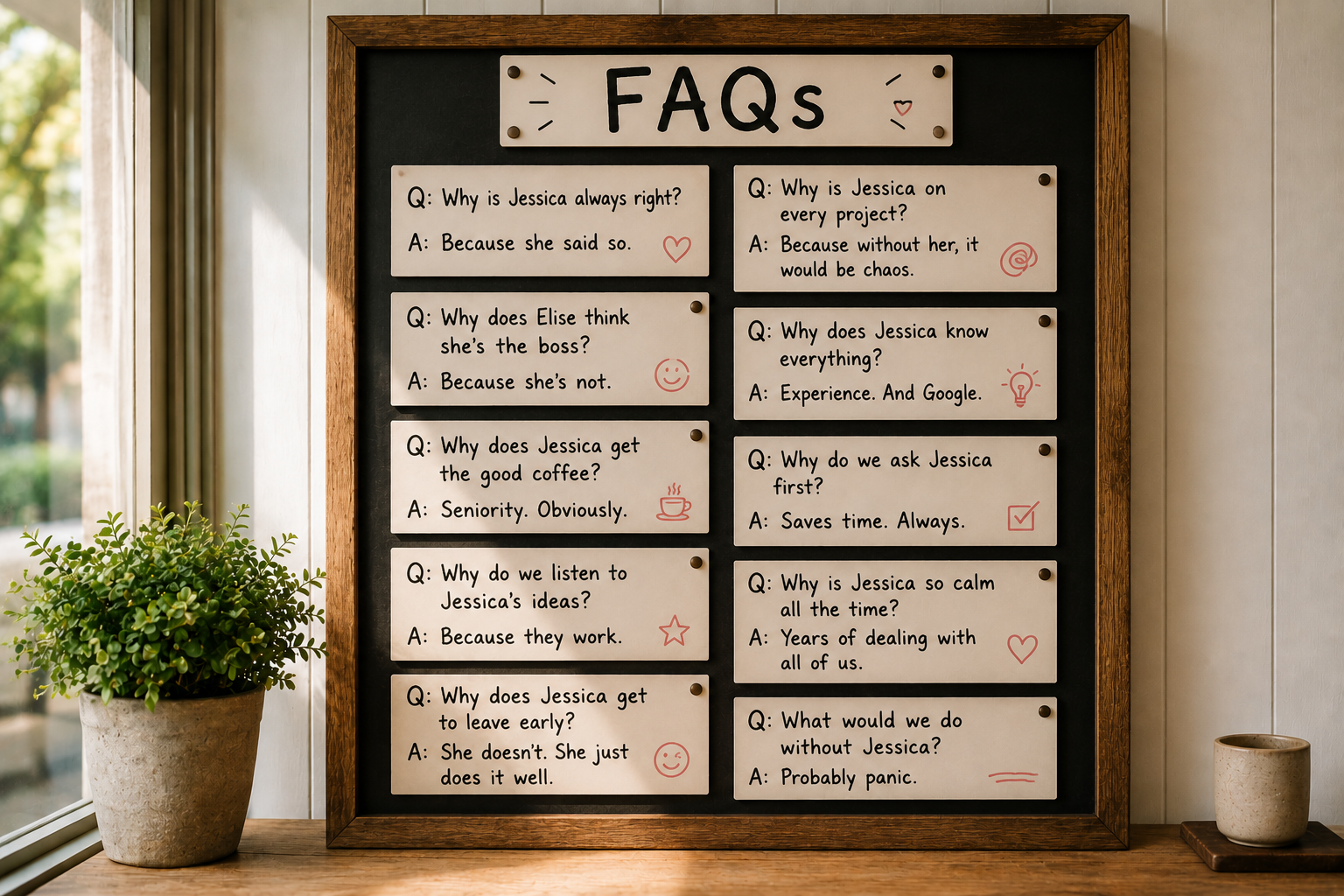
What an FAQ page is actually for
A good FAQ page quietly serves two very different audiences at once. There’s the nervous customer, sitting there deciding whether to trust you, hoping you’ll just answer the thing they’re too polite to email about. And there’s the search engine, trying to match your page to the question-shaped things people type into Google all day.
Here’s the lovely part: you serve both the same way. By answering the question. Clearly, in plain words, where they can find it. That’s it. That’s the whole trick.
How FAQ pages go feral
Left unsupervised, FAQ pages develop bad habits. The usual suspects:
- Questions nobody asked. “Why are we the best in the business?” is not a question — it’s an ad wearing a question mark. Real one: “How much does it cost?”
- Answers that dodge. “Every project is unique!” is a polite way of saying “we won’t tell you,” and everybody reads it that way.
- Marketing waffle where a straight answer should be. People came for a fact, not a brochure.
- Over-engineered everything. Fancy accordions, animations, and pop-ups that hide the answer behind three taps and a loading spinner.
- Avoiding the awkward ones — price, timeframe, “what if it goes wrong” — which are the exact questions people opened the page to answer.
NORM (a customer): Your FAQ page didn’t actually say how much anything costs.
THE BOYS: …fair, Norm. That’s pretty much the whole reason a person opens an FAQ.
ELISE: If the page won’t answer the real question, the customer just leaves and asks a competitor who will.
(One FAQ page Jessica visited played a video, asked for her email, and somehow launched a platypus. It never did answer the question. The platypus also seemed unsure why it was there.) 🐨

How to write FAQs that actually work
Good FAQ writing is almost boringly simple, which is exactly why so few people do it:
- Use the real words people type. Write the question the way someone would Google it — “How much does a website cost?” — not “What is our pricing philosophy?”
- Answer in the very first sentence. Give the answer, then add detail. Never make someone read a paragraph to find out you said “it depends.”
- One clear answer per question. No essays, no detours, no upsell mid-sentence.
- Cover the awkward ones on purpose. Price ranges, timeframes, what happens if something goes wrong. Answering those honestly is the single biggest trust-builder you have.
The test: read each answer and ask, “Would this actually satisfy someone genuinely wondering?” If it dodges, waffles, or sells instead of answering — rewrite it until it just answers the question.
The SEO bit (the honest version)
FAQ pages are quietly great for search, but not for the reason you’ll often hear. They work because they match how people actually search — in questions — and because answering those questions clearly keeps people on your site and builds trust.
You can mark FAQs up with FAQ structured data so search engines understand them — and you should — but here’s the honest bit most won’t tell you: Google pulled back those fancy FAQ “rich results” for most ordinary sites a while ago. So don’t write your FAQ chasing a flashy search snippet. Write it to genuinely answer the question. A clear, useful FAQ is also a natural home for links to your SEO and service pages — helpful for the reader, and tidy for search at the same time.
A good FAQ answers the question before the customer has to ask it twice.
If your FAQ page is more circus than answer sheet, it’s an easy, high-value fix. Our free Website Check will flag where your pages are confusing search engines, and we’re always happy to help turn a wall of waffle back into plain, useful answers.